Metal roof valley flashing is the detail most likely to fail first on a Sarasota County roof, often long before the panels show any wear. Every valley funnels rain, leaves, and storm debris into one narrow channel, and a weak lap or undersized pan there turns into a ceiling stain fast. This guide covers the materials, code minimums, and failure signs Sarasota County homeowners need to keep that channel watertight.
What Metal Roof Valley Flashing Actually Does
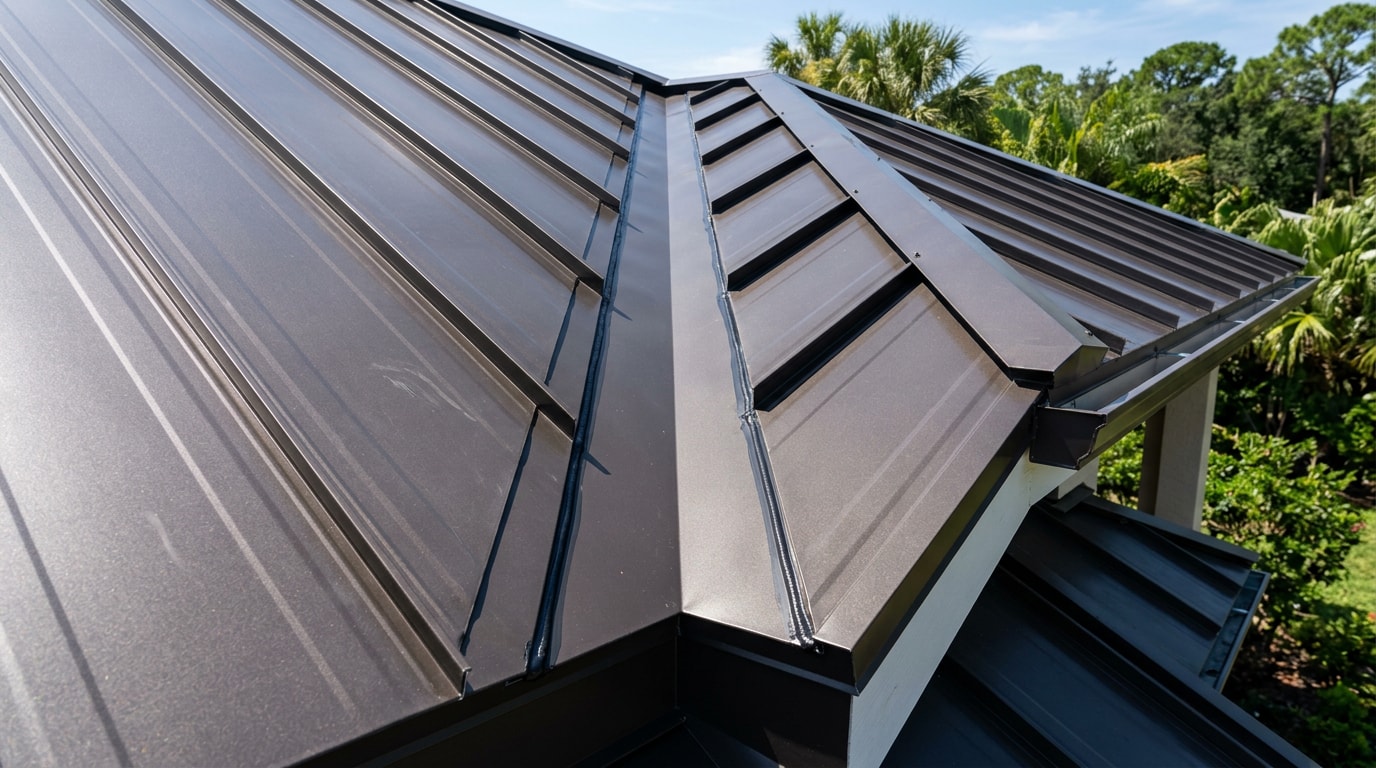
A valley is where two roof slopes meet and drain into each other. Water volume there is far higher than anywhere else on the roof, which is why the flashing has to be heavier gauge and installed with tighter tolerances than the field panels around it.
In our years inspecting roofs across Sarasota County, our crews have traced more storm leaks back to undersized or improperly lapped valley pans than any other single failure point on the roof. Loose debris, pine needles, and shingle grit collect in that channel too, which accelerates corrosion if the flashing material isn't matched to the exposure.
Getting this detail right matters more here than almost anywhere else in Florida. Want a second opinion on your own valley condition? Request a free estimate and we'll take a look before the next storm season.
Open Valley vs. Closed Valley: Which Fits Sarasota County Roofs
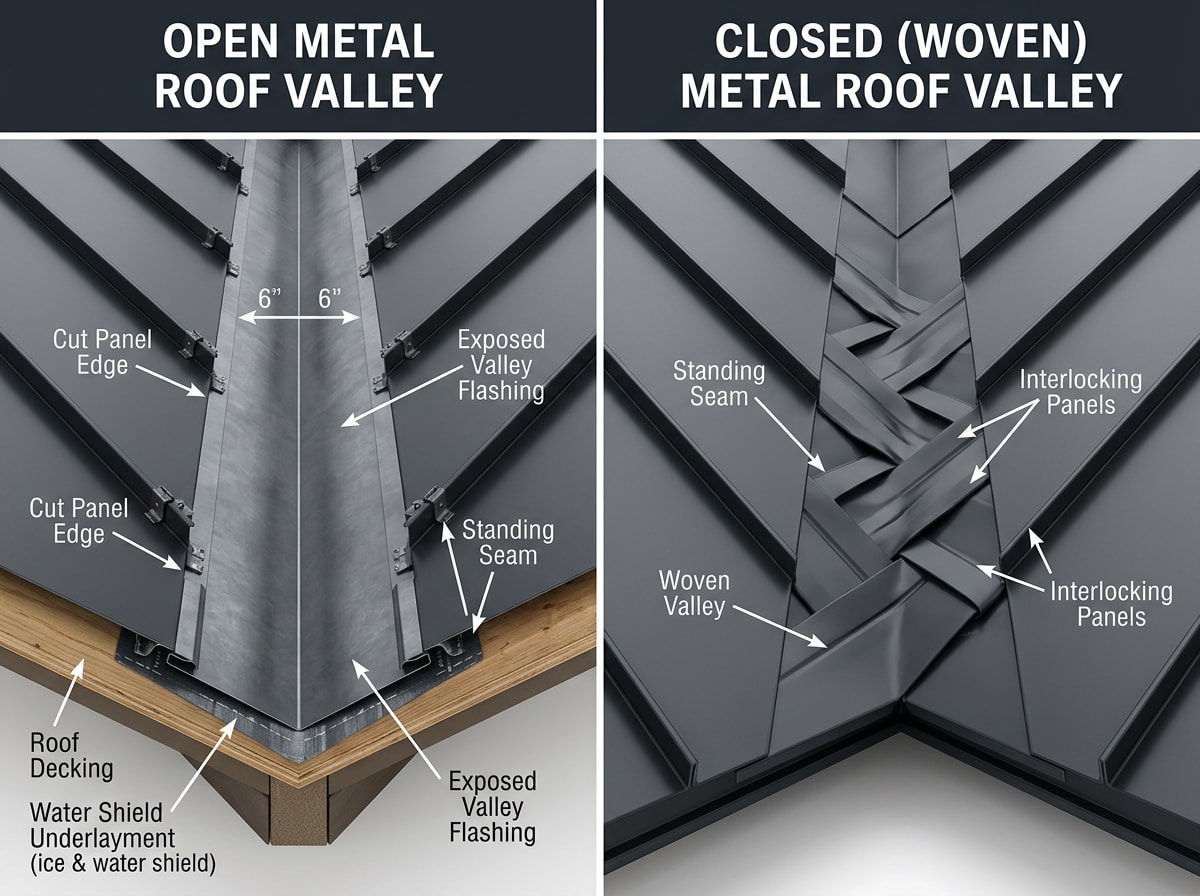
Metal roof valleys are built one of two ways, and the choice affects how well the roof sheds Florida's heavy, fast-moving rain.
| Valley Type | How It Works | Best For | Watch-Outs |
|---|---|---|---|
| Open Valley | Metal channel stays exposed; panels are cut back on both sides | Heavy rainfall areas, most Sarasota County homes | Needs periodic debris clearing to keep the channel flowing |
| Closed (Woven) Valley | Panel edges tuck together over the flashing | Architectural styles wanting a seamless look | Can trap debris and hide corrosion if not detailed carefully |
| W-Valley | Open valley with a raised center rib | Complex rooflines with multiple intersecting slopes | Rib must be fabricated to spec or cross-wash still occurs |
Open valleys generally drain faster and are easier to inspect, which is why most licensed roofers recommend them for this climate. Closed valleys look cleaner but require a more careful hand during installation.
Best Materials for Coastal Valley Flashing
Salt-laden air drifts in from the Gulf and settles on every exposed metal surface, speeding up corrosion wherever a flashing material isn't suited for it. The material choice at the valley matters as much as the panel choice on the rest of the roof.
| Material | Corrosion Resistance | Typical Fit |
|---|---|---|
| Galvalume Steel | Good inland, moderate near salt water | Standard installs away from the immediate coastline |
| Aluminum | Excellent, naturally corrosion-resistant | Coastal and barrier island properties |
| Stainless Steel | Excellent, resists pitting and rust streaking | High-exposure valleys and premium installs |
| Copper | Outstanding, develops a protective patina | Historic or high-end homes, longest service life |
| Zinc | Very good, self-healing surface | Premium installs, long-term low maintenance |
Galvalume works fine for most inland Sarasota County roofs, but homes near Siesta Key, Venice, or the Gulf frontage tend to hold up longer with aluminum or stainless valley metal.
Florida Building Code Requirements for Valley Flashing
Florida's residential building code sets hard minimums for valley flashing, and these aren't optional upgrades. Roof valley flashing must be corrosion-resistant metal of the same material as the roof covering, must extend not less than 8 inches from the centerline each way, and must have a splash diverter rib not less than 3/4 inch in height at the flow line.
That splash diverter rib is easy to miss on a quick visual inspection, but it's the detail that stops wind-driven rain from washing straight across the valley and under the opposite panel. Skipping it, or using an off-spec pan to save material cost, is one of the more common reasons a new metal roof develops a valley leak within the first year or two.
Signs Your Valley Flashing Is Failing
A failing valley rarely announces itself with an obvious leak right away. Look for these signs during routine walk-arounds or after any named storm:
- Lifted metal laps or panels pulling away from the valley pan
- Debris damming that traps standing water against the deck
- Rust streaking or pinhole corrosion along the flashing edges
- Cracked, peeling, or missing sealant at laps and penetrations
- Ceiling or attic stains that trace back toward a valley, even if the stain itself is feet away
Catching any of these early during a scheduled roof inspection costs far less than repairing the interior water damage that follows a missed valley failure.
How Valley Flashing Gets Installed and Repaired
Whether it's new construction or a repair, correct valley work follows the same sequence:
- Prep the deck and confirm there's no rot or soft spots before anything goes down.
- Install self-adhering, high-temperature underlayment along the valley centerline, extending well past the valley on both sides.
- Set the valley metal pan, typically a heavier gauge than the field panels, centered precisely over the valley line.
- Cut back field panels from the valley edge and lap them over the pan at a consistent reveal.
- Fasten and seal all laps and penetrations per manufacturer spacing before the next course goes on.
Our crews, led by Florida-certified contractor Thomas Jacques (License #CCC1329935), have handled valley flashing on everything from new installs to storm repairs across Sarasota County for more than a decade, and undersized flashing pans are consistently the most common corner cut we find on older roofs. If your roof needs more than a spot repair, a full roof replacement is often the more cost-effective long-term fix once a valley has failed more than once.
After a Storm: Valley Flashing and Insurance Claims
Sarasota County sits in hurricane country, and valley flashing is one of wind-driven rain's favorite targets. Hurricane Milton made landfall in Sarasota County in October 2024, and the Florida Office of Insurance Regulation recorded 31,786 Milton-related insurance claims filed in Sarasota County alone, with roughly 94 percent of those claims eventually closed . Roof damage, including flashing and valley failures, made up a large share of that volume.
Documenting storm-related valley damage right after a storm strengthens any insurance claim. Photograph lifted laps, debris damming, or sealant failure as soon as it's safe to get on the roof, and have a contractor put a written assessment in writing tying the damage to the specific weather event.
Homeowners in North Port, Venice, and across Sarasota County deal with this same exposure every storm season, and our team at Avery Roof Services handles both the repair and the documentation side of these claims.
Does Valley Flashing Affect Energy Efficiency?
Reflective metal roofing cuts cooling costs compared to dark asphalt shingles, but that benefit only holds up if the roof stays watertight. A cool roof can lower air conditioning costs on a hot day and even reduce the surrounding air temperature, which helps limit the urban heat island effect. A compromised valley lets moisture into attic insulation, which undermines those efficiency gains regardless of how reflective the panel finish is.
If your roof coating has worn thin or you're exploring reflective finishes, our roof coating team can walk through which options still make sense for your roof's age and exposure.
How Long Should Valley Flashing Last?
Panel life and flashing life aren't the same number. Field inspections of low-slope, unpainted 55% Al-Zn alloy-coated steel standing seam roofs with up to 35 years of service found that the systems can be expected to last in excess of 60 years when installed with best practices. Valleys and penetrations, however, age faster than the flat panel field because they see more water volume, more thermal cycling, and more debris contact.
Most premature metal roof failures in Florida trace back to flashing and sealant issues, not panel corrosion. That's the detail worth having checked before you assume a roof's remaining lifespan matches its panel warranty.
For related reading on flashing specifics elsewhere on the roof, see our guide to roof vent flashing in Bradenton, FL, which covers the same underlayment and lap principles applied to penetrations instead of valleys.
FAQ
What is metal roof valley flashing?
It's the metal channel installed where two roof slopes meet, built to carry rainwater off the roof instead of letting it seep under the panels. It's the highest-stress point on most roofs because it handles more water volume than any other section.
How much does valley flashing repair cost in Sarasota County?
Cost depends on valley length, material grade, accessibility, and whether underlayment also needs replacing. Request a free estimate for an exact number on your roof rather than relying on a generic average.
Should you put underlayment under a metal roof valley?
Yes. Valleys need a heavier-duty, self-adhering, high-temperature underlayment rather than standard synthetic sheet, since they carry far more water volume and sit under the hottest part of the roof during summer.
How long does a metal roof typically last in Florida?
Well-installed steel standing seam systems can exceed 60 years under best-practice conditions, according to Metal Construction Association field studies. In practice, most premature failures in Florida trace back to flashing and sealant issues at valleys and penetrations rather than panel corrosion.
Can you assist with insurance claims for valley flashing damage?
Yes. Documenting storm-related valley damage is routine after Sarasota County hurricanes. That means photographing lifted laps, debris damming, or sealant failure right after a storm, paired with a written assessment tying the damage to a specific weather event.
Do you provide warranties on valley flashing repair work?
Most flashing repair work carries two separate warranties: a material warranty from the flashing manufacturer and a workmanship warranty covering installation. Workmanship warranties on valley repairs commonly run one to several years depending on scope, so confirm the specifics before work begins.